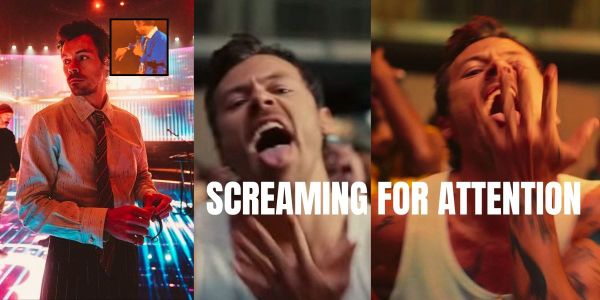
IT’S ONLY LOVE: PERFORMANCE ART by HARRY STYLES
Styles is a master at performing the aesthetics of a liberated, sensitive man, he wears feather boas, sings about female pleasure, and admits to being sad, but he fails to embody the substance of vulnerability required for deep true love.

Harry Styles performs the idea of vulnerability (being open about his feelings) as substitute for the reality of it (the quiet, consistent, and sometimes uncomfortable work required for deep intimacy). It's infused into many (most) of his lyrics from the beginning with HS1. This creates a fascinating tension in his work but a sad reality in his private life.
Part 1: The Two Sides of Harry's Persona
Based on an analysis of his lyrics, public statements, and critical reviews, there is a consistent tension between two personas: the sexually confident "Pop Star" and the emotionally wounded "Sad Boy." However, the "Sad Boy" persona often focuses on his own pain rather than the work of a mutual, vulnerable relationship. Most of Harry’s lyrics are about himself and his problems while playing the victim. This is classic covert narcissistic behavior which we have seen in various forms from Harry for nearly 15 years.
1. The Performance of Sex (Confidence and Objectification)
This persona is about physical pleasure, confidence, and often, a lack of emotional responsibility. Critics argue this side of his music can be "lackluster" and dehumanizing.
- "Watermelon Sugar" (2019): The quintessential sex anthem. Styles famously described it on stage as being about "the female orgasm". The song is a celebration of physical sensation with lines like "I just wanna taste it," focusing on pleasure without emotional consequence.
- "Cinema" (2022): Criticized for the lyric, "If you’re getting yourself wet for me, I guess you’re all mine," which one review called objectifying and possessive, treating a partner as a belonging rather than a person. Again, something we have witnessed often over the years, particularly related to his bandmate, Louis Tomlinson.
- "Music For a Sushi Restaurant" (2022): Uses food as a metaphor for desire with the line, "I could cook an egg on you," which has been described as dehumanizing.
- “Keep Driving" (2022): The hedonism log. A fragmented, stream-of-consciousness road trip through drugs, alcohol, and pleasure itemized like a grocery list. There's no emotional arc, no consequence, no other person who truly registers. The whole song is a philosophy: keep consuming, keep moving, and feeling anything deeply is someone else's problem.
- “Lights Up" (2019): Presented as liberation, but there's a controlling undertow. The song is about being seen — but only on his terms, only when he steps into the light, "only when the lights go out." He demands to be witnessed fully while remaining strategically elusive, visible when it serves him and gone when it doesn't. Freedom as a one-way street: his.
- "Satellite" (2022): The most self-aware song about emotional unavailability he's ever written — which somehow makes it worse. He compares himself to a satellite: orbiting close, watching, but constitutionally unable to land. "Spinning out, waiting for ya to pull me in" places the entire burden of emotional rescue on the other person. It's dressed up as longing, but the architecture is narcissistic — you fix this, I'll keep circling.
And we haven't even begun to talk about Kiss All the Time. Disco, Occasionally, (released March 6, 2026) and some of the self-absorbed drug and sex charged lyrics on that album. We'll come back to that another time.
2. The Performance of Vulnerability (Sadness and Fear of Loneliness)
This persona is about heartbreak, loneliness, and fear of abandonment. However, it often frames vulnerability as something he is rather than something he does with another person.
- "Falling" (2019): A powerful ballad of self-loathing and regret: "What am I now? What if I'm someone I don't want around?". This is vulnerable, but it's a solo performance of guilt, focused on his own shortcomings.
- "Golden" (2019): The line "I know that you're scared because I'm so open" positions him as the emotionally available one, while his partner is closed off. Live versions included the lyric, "Golden, he is broken," suggesting a one-way dynamic. Of course, Harry seems to claim he has all his shit together, while his partner is the problem.
- "Fine Line" (2019): The title track includes the line, "Spreading you open / Is the only way of knowing you." Analysts suggest this implies a struggle with emotional connection, leading him to settle for a physical relationship as a substitute for true intimacy.
- "Coming Up Roses" (2026): This song captures "romantic uncertainty." It acknowledges self-sabotage: "I'm not devoid of an appetite" and "Now I see your tears on account of my wants." The narrator recognizes he is causing pain but remains stuck in "hangover chasing" rather than offering resolution.
Part 2: What Personality Traits Does It Take to Deeply Love Someone?
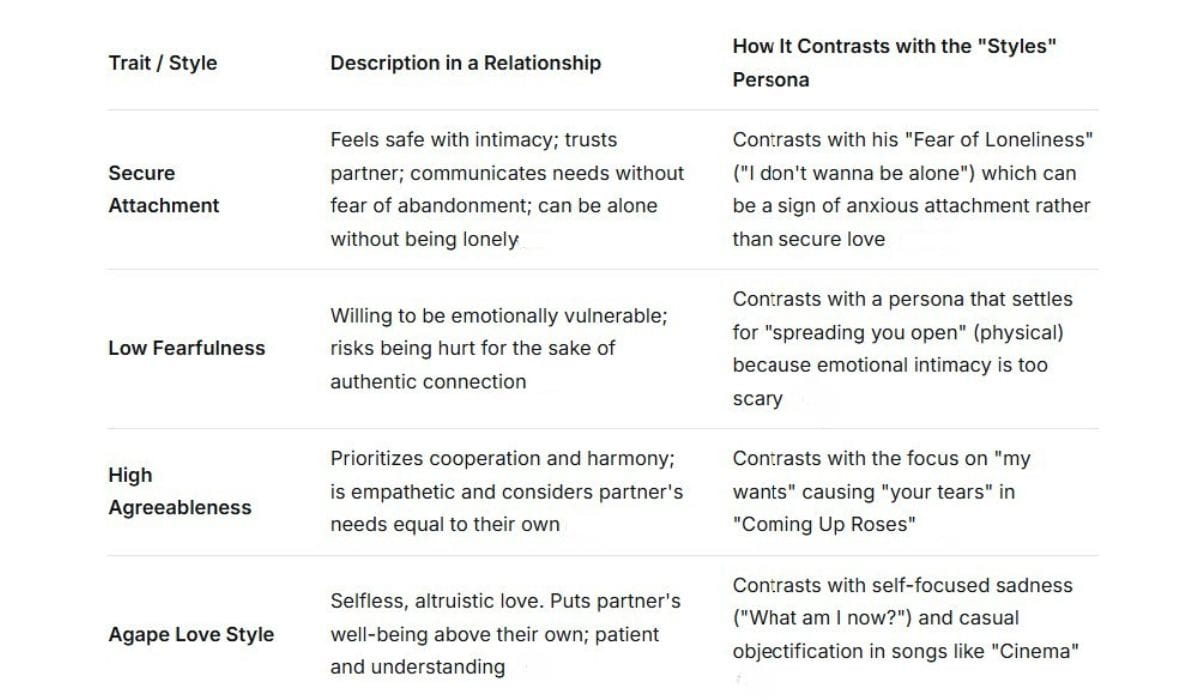
Deep, lasting love is less about passionate declarations (like a pop song) and more about consistent personality traits and attachment styles. Psychological research identifies several key components:
Part 3: Synthesis
Styles is a master at performing the aesthetics of a liberated, sensitive man, he wears feather boas, sings about female pleasure, and admits to being sad, but he fails to embody the substance of vulnerability required for deep true love.
1. Confusing "Being Open" with "Being Vulnerable"
Styles often sings about being the "open" one. However, true vulnerability is a two-way street. It requires risking the loss of control. Some of his fans think this is only about queer identity, but we think this involves his entire emotional persona. As seen in "Fine Line," when faced with a partner who isn't "open," he retreats to what is easy: "Spreading you open / Is the only way of knowing you". This suggests that when emotional intimacy becomes difficult, he defaults to physical intimacy. A person capable of deep love would wait for the emotional connection to develop, rather than treating the physical as a shortcut.
2. The Narcissism of the "Sad Boy"
Tracks like "Falling" and "To Be So Lonely" are incredibly effective at eliciting sympathy. However, they are focused on his own internal state: I am loathsome, I am lonely, I am sorry for my arrogance. In contrast, a trait like Agape (selfless love) would require the focus to shift from his own guilt to the actual pain he caused the other person. "Coming Up Roses" touches on this ("Now I see your tears on account of my wants") but resolves it by returning to the cocoon of "me and you" rather than offering a solution, change, or apology.
3. Sex as a Substitute for Intimacy
There is a long list of songs where sex is either an act of conquest ("Cinema") or a distraction from loneliness ("Watermelon Sugar"). Research on love styles shows that deep intimacy is correlated with low levels of Ludus (playful, game-playing love) and high levels of Storge (friendship-based love). Styles rarely sings about the mundane, boring, or difficult parts of partnership—the "backseating your life / Judgin' while you drive". Instead, he sings about the highlights: the sex and the sadness that follows when the highlights end, then constantly seeking more pleasure to compensate for the lack of depth he can't feel. A solid loving relationship cannot function long term in this environment.
Harry Styles has rebranded his classic pop rock-star tropes (sex, drugs, and heartbreak) as modern emotional intelligence. However, by examining his work, it becomes clear that he is trapped in a cycle of physical pursuit and individual sadness. The personality traits required for deep love, secure attachment, selflessness, and the courage to endure boredom and conflict, are notably absent from his persona, replaced by a more cinematic, and ultimately safer, performance of vulnerability.