The Ghost in the Machine: Could AI Resurrect One Direction—And Should It?
In the last few years, probably in a conference room with lawyers, tech consultants, and label executives counting potential revenue streams, there was a conversation about artificial intelligence and its seismic implications for the music industry. Specifically: bands like One Direction.
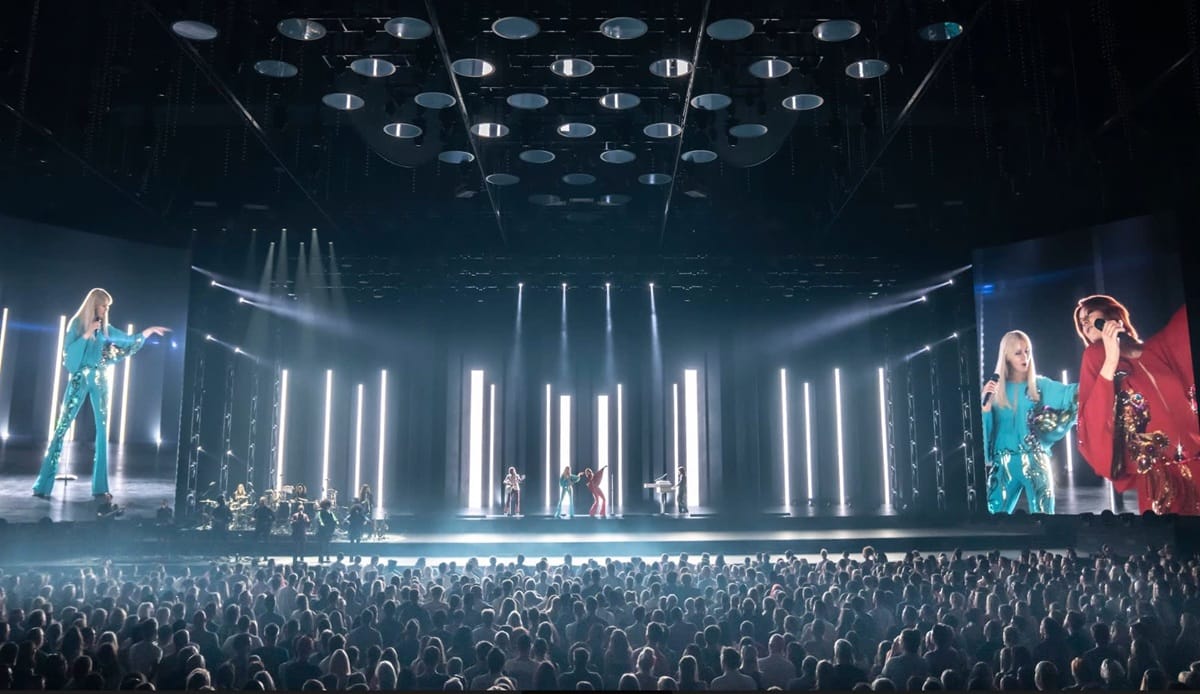
A pop star drives a vintage Simca (a 1959 French car) through his promotional campaign, hands finally on the wheel after years of backseat navigation. Meanwhile, in London, holographic avatars of ABBA rake in millions nightly, performing to crowds who weren't even born when "Dancing Queen" topped the charts. Between these two points—one man's hard-won creative autonomy and the music industry's newest cash cow—lies a question that could reshape pop music's past, present, and future: What happens when the technology to resurrect dead bands meets the fractured reality of One Direction?
The Setup: When Control Becomes Currency
Louis Tomlinson's Lemonade / How Did I Get Here era isn't just branding, it's a manifesto. The album title, the tour, that old Simca: it's businessman Louis in full force, finally driving his own career trajectory. He's looking back but he’s driving forward.
This matters because sometime in the last few years, probably in a conference room with lawyers, tech consultants, and label executives counting potential revenue streams, there was a conversation about artificial intelligence and its seismic implications for the music industry. Specifically: bands like One Direction with massive, obsessive followings and complete catalogs of recorded material sitting in Sony's vaults. Louis Tomlinson was in that room. It’s possible he may have even started that conversation.
He's always been the smart one, from day one. The member who thinks three moves ahead while claiming he's winging it. Yes, we think it's a little odd that, in recent interviews, he's been talking about how drunk he was at certain times and how he’s found his inner hippy. We think he's downplaying himself for a reason, but we'll get to that in a Louis deep dive.
He was the one who wanted creative control so badly he resisted the path others took. Whether by wisdom, stubbornness, or sheer cosmic intervention, he waited. Personal tragedies and confidence issues kept him tethered to Simon Cowell's empire until 2020, but the resistance was always there.
The Threat: Your Reunion, With or Without You
The conversation wasn't about if artificial intelligence could recreate a One Direction reunion. It was about when it would happen—with or without the band members' blessing.
Sony owns the footage. They own the voice stems. They own the master recordings. With current AI technology, they could theoretically build a reunion show from existing material: the voices extracted and reconstructed, the choreography motion-captured from old concert films, the avatars rendered to whatever age they choose. The boys might hate it. They could sue. But litigation takes years, costs millions, and they'd probably lose anyway because the label owns the underlying assets.
The industry has the tools. They have the motive (money, obviously). What they didn't have was the right moment—or the blueprint for how to make it culturally viable.
Then ABBA Voyage opened in May 2022
The Blueprint: Why ABBA Worked (And Why That's Complicated)
ABBA Voyage isn't just a concert—it's a technological epilogue. Four holographic "ABBAtars," rendered to their 1970s prime through motion-capture performances by the actual band members (now in their 70s), perform a 90-minute set in a purpose-built London arena. It's pure, uncomplicated nostalgia: a definitive final bow for a band with a universally beloved, closed catalog and zero interpersonal drama splashed across tabloids.
It works because:
- Unified consent: All four members participated and signed off
- Complete narrative: ABBA's story has an ending—they broke up in 1982, occasionally made appearances, released a reunion album in 2021, and now exist as permanent digital ghosts
- Timeless catalog: Their music is synth-pop theatrical perfection, built for spectacle
- Passive fandom: ABBA fans love the music; they're not analyzing which member gets more screen time or comparing solo careers
One Direction is none of these things.
The Fracture Points: Why 1D Is Different (And Harder)
1. The "Unfinished" Problem
ABBA's story ended. One Direction's didn't—it paused. The "indefinite hiatus" announced in 2015 was always framed as temporary, even when everyone knew it probably wasn't. The fan desire isn't for a nostalgic farewell; it's for the completion of an interrupted narrative. They want closure, not a eulogy.
That creates a fundamentally different technological and emotional challenge. Do you freeze the band in amber at a specific era? The fresh-faced "What Makes You Beautiful" babies? The more mature "Midnight Memories" phase? Or do you age them up, creating a virtual reunion that shows what they'd look like as a unit now—even though they all have radically different aesthetics and public personas? But that’s even more complicated since Liam Payne’s passing.
2. The Five-Man Problem (Or Four-Man, Or Three-Man)
ABBA needed four approvals. One Direction needs five. Could a 1D Voyage work with four avatars? Could it work with three if, say, Harry Styles' management says no?
Each missing member fractures the illusion differently. Liam is gone and what if Harry opts out? That's the most successful solo artist explicitly rejecting the project. It wouldn't just be a business decision; it would be Harry Styles saying no to you, which is a different kind of wound for a fandom that's built its identity on fan love and TPWK.
3. The Solo Career Minefield
This is the nuclear issue: For Harry Styles, Louis Tomlinson, Niall Horan, Liam Payne (before his death in October 2024), and Zayn Malik, their solo brands are now their primary identities.
- Harry is a Grammy-winning, Oscar-nominated megastar whose brand is built on not being a boy band member
- Louis fought like hell to escape management's grip and establish himself as an indie-rock-influenced artist with creative control
- Niall is a respected adult-contemporary star
- Zayn explicitly rejected the boy band model and crafted an R&B alternative persona
An AI reunion complicates every solo narrative. Does it help or hurt Harry's artistic credibility? Does it make Louis look like he's cashing in after fighting so hard for autonomy? How do you split profits—equally, or based on participation, or by which avatar gets more stage time? Does this project preclude a future real reunion? What's the incentive for the most successful member versus the least?
4. The Fandom as Co-Creator
ABBA fans consume music. Directioners create it. They write fanfiction, run update accounts, organize charity drives, construct elaborate theories, and most importantly: they hold grudges. They track streaming numbers. They analyze who interacts with whom on social media. They have factions.
There's no such thing as a unified Directioner fandom in 2026. There are Harry stans, Louis stans, Larries (who believe Harry and Louis are secretly in a relationship), Ziam truthers, and a thousand micro-communities with competing narratives about what the band meant and why it ended.
An AI reunion doesn't just have to satisfy fans—it has to navigate a minefield of pre-existing conflicts about whose story gets told, whose avatar gets the spotlight, and whether this is a respectful tribute or a cynical cash grab.
One wrong move, and you've weaponized, arguably, the most powerful stan culture on the internet against your own project.
The Tech Challenge: Translating Boy Band Energy to Virtual Space
ABBA's music is theatrical. It's synth-driven, high-energy, built for choreographed spectacle. One Direction's music is guitar-and-vocal-driven pop with boy band choreography—but the magic was always in the connection. The screaming crowds. The direct address to camera. The sense that you, specifically, were being sung to.
How do you translate that intimacy into a virtual environment?
A 1D Voyage couldn't just be a stadium show with holograms. It would need to feel like you're with them—the parasocial relationship made tangible. That requires:
- Interactive elements: Avatars that respond to crowd energy, maybe even "recognize" signs or audience participation
- Narrative structure: Not just a setlist, but a story that contextualizes the hiatus and gives emotional closure
- Era fluidity: Maybe the avatars morph through different periods, acknowledging the full timeline from "Up All Night" to "Made in the A.M."
You'd need the visual spectacle of ABBA Voyage combined with the emotional architecture of a Marvel movie. It's technically possible—but exponentially more expensive and creatively complex.
The Industry Value: Why This Matters Beyond One Band
If a One Direction AI reunion could work, it would fundamentally reshape the music industry's relationship with legacy acts. Here's what's at stake:
1. The Catalog as Perpetual Asset
Right now, a band's commercial lifespan is tied to the members' willingness and ability to perform. AI severs that connection. Your catalog becomes a living asset that can be repackaged, recontextualized, and resold indefinitely—no retirement, no aging, no death.
2. The Rights Revolution
This forces a reckoning with how recording contracts are structured. If Sony can create AI performances from masters they own, where does the artist's right to control their image end? Current contracts don't account for this. Expect litigation that makes the Napster wars look quaint.
3. The Fandom Economy
One Direction proved that fandom is an economic force that rivals traditional industry power. If you can keep a fandom engaged without the actual artists—through AI performances, virtual meet-and-greets, even algorithmically generated "new" music—you've created a perpetual revenue machine. But you've also potentially created a dystopian nightmare where fans are consuming simulacra while the real artists are sidelined.
4. The Precedent for Every Band That Ever Broke Up
The Beatles. NSYNC. Destiny's Child. TLC. The list of bands whose reunions are worth hundreds of millions but will never happen (due to death, feuds, or indifference) is long. If One Direction proves the model works, every label with a legacy catalog will race to build their own 'Voyage'.
The question isn't whether this can happen. It's whether artists can maintain control of their own legacies in an industry that's proven, repeatedly, it will exploit every possible loophole.
The Ghost in the Calculation: Liam's Death
On October 16, 2024, Liam Payne died after falling from a hotel balcony in Buenos Aires. (Yeah, we don't agree with that story, but that's another discussion.)
His death didn't just complicate the idea of a reunion—it made it grotesque. How do you build an AI avatar of someone who's just died? Do you include him or leave him out? Either choice is monstrous in different ways. Include him, and you're resurrecting a dead man for profit. Exclude him, and you're erasing him from the band's history.
ABBA Voyage worked because all four members consented and participated in the motion-capture. It was a collaboration. A One Direction Voyage built without full participation would be ventriloquism—and now, with Liam gone, it's ventriloquism of a corpse.
The only ethical path forward would require the remaining four members to explicitly endorse the project and participate in its creation. That means Harry would have to say yes. Zayn would have to come back. Louis would have to agree to share control. Niall would have to be convinced it's not exploitative.
The odds of all that happening? Near zero.
The Man in the Simca: Louis's Calculated Bet
Which brings us back to Louis Tomlinson and that vintage car. If anyone in One Direction has been gaming this out, strategizing for the moment when the industry makes its move, it's him. Louis is controlling his narrative, his sound, his future (but not without the industry breathing down his neck with demands).
But here's the edgiest possibility: What if Louis is the one who makes the AI reunion happen—on his terms, with full artist consent and creative control, as a way to give the fandom closure while protecting everyone's solo careers?
It would be the ultimate act of the businessman he's become. Not a betrayal of autonomy, but an exercise of it. Taking the weapon the industry was going to use anyway and turning it into something the band—or what's left of it—actually controls.
Imagine: A limited run. A carefully crafted narrative that honors Liam without exploiting him. A technological showcase that doesn't preclude future real reunions. Profits split fairly. A farewell that's actually on the band's terms.
Would It Work?
Technologically? Yes. The tools exist.
Financially? Probably. Directioners are a diaspora now, scattered into adulthood, but they're also professionals with disposable income and a hole in their hearts shaped like 2012.
Ethically? That's where it falls apart.
ABBA Voyage works because it's a mutual agreement between artists and industry to create a technologically ambitious farewell. A One Direction Voyage, without full consent and participation, would be exploitation dressed up as innovation.
The music industry wants to believe that AI can resurrect any band, print money forever, and sidestep the messy reality of human artists with agency and trauma and conflicting agendas. Maybe it can. In a few years they will have normalized the sound and effect, at least for the younger generation less invested in originality and the true creative art of music from the human soul.